
[English Version] Interview with David Candaux
최종 수정일: 2월 26일


You unveiled the DC12 MaveriK last year. You mentioned that it took 17 years to conceive and complete. Why did it require such a long period of time?
Seventeen years was never part of an initial plan. It simply reflects the time required to solve the problem. You always know when a project begins, but you never know when it will be finished. The DC12 is not merely a personal creation—it embodies nearly a century of watchmaking heritage and spirit from the Vallée de Joux.
This concept first appeared in the 1930s as an experimental pocket watch developed at the region’s technical school (École Technique). Then, in 1996, Philippe Dufour miniaturized it into a wristwatch with the Duality, proving its feasibility. My role was to bring this concept to completion in a form suitable for a modern wristwatch.
The double balance system improves precision by averaging the performance of two independent regulators. However, a fundamental contradiction exists: each balance requires its own energy. When both are powered simultaneously from the same source, interference and instability may occur, even leading to stoppage. The traditional solution has been to position the differential away from the seconds train. While mechanically more stable, this approach ultimately limits the level of achievable precision.
To address the root of the problem, I chose to place the differential at the very center of the seconds train—the most demanding and technically challenging location. The first prototype failed entirely, and the second, completed years later, functioned only partially. Finally, in 2023, the decisive idea emerged: a flying satellite planetary system integrated into the hairspring shock absorber.
The turning point came when I stopped trying to control force and instead learned how to guide it. This system follows the motion of the balances, absorbing variations in force and dynamically compensating for them, allowing each regulator to reach its own natural equilibrium. Through patience, perseverance, and resilience, the DC12 was ultimately realized. Reliable, ergonomic, and crafted entirely in titanium, it represents the culmination of a long-pursued vision of mechanical integrity.
The C30 calibre incorporates three new patented technologies. How did each of these come into existence?
Each patent arose from a genuine mechanical necessity.
The flying satellite planetary differential, integrated into the system, is positioned at the center of the seconds train and mounted on the hairspring shock absorber. It calculates in real time the oscillation rates produced by the two independent balances and determines their average value. This is fundamentally different from resonance. The two balances neither synchronize nor directly influence one another. Instead, the differential measures their individual performance and transmits the averaged result to the seconds display. The hairspring absorbs variations in force and flexibly distributes the energy required by each balance.
The second patent is the secured winding system. Two balances demand more energy, so the click and spring serve as safety mechanisms, preventing unwanted reverse torque.
The third patent is the coaxial inclined control mechanism, known as the “Magic Crown,” located at 6 o’clock. Composed of more than 30 components, this structure allows the two barrels to be wound independently or disengaged during time setting. This architecture defines the ergonomic structure of all my watches, ensuring that the case naturally conforms to the wrist.
Was there a particular reason why Philippe Dufour’s “Duality” became such a decisive source of inspiration?
Philippe’s work is part of a lineage that I deeply respect. This concept originated in 1930, and in 1996, Philippe successfully realized it in a wristwatch. In 2025, my goal was to bring it to completion in a form suited to modern wristwatches, with mechanical stability and dynamic balance.
We share the same village, Le Solliat, and studied under the same master, Gabriel Locatelli. The DC12 introduces an unprecedented mechanism of dynamic compensation through its flying satellite system. It is entirely new, with a fundamentally different mechanical philosophy.
The caseback architecture, designed around the double balance wheels, has drawn significant attention. What efforts were required to achieve this kind of structural beauty?
I focused not on decorative elements, but on what I would call “natural beauty.” Within perfect balance, lines and flows derived from nature connect organically. The caseback reveals the two independent balances, while at 12 o’clock, a three-dimensional differential links them. The bridges were elongated and finished with straight graining inspired by historical movements from the Vallée de Joux. The central bridge is hand-finished with snow graining. The polished inward angles eliminate stress concentration, while the brushed flanks reduce friction.
What was the most challenging moment during the development of the movement?
When testing the first prototype, even while seeing the mechanism actually running, you still doubt whether it will stop. What follows are weeks of validation and reliability testing, and years spent understanding and accepting failure. It is like climbing a mountain over and over again. Yet these experiences strengthen you, and the more difficulties you encounter, the faster you move toward the solution.
In this new creation, instead of a tourbillon, you chose an openworked structure at 12 o’clock revealing two balance wheels and the differential. Why?
The tourbillon was invented to improve the precision of pocket watches, which remained in a vertical position. On the wrist, the conditions are different. That is why, in previous collections, I developed a 30-degree inclined tourbillon to address positional variations on the wrist.
However, in a wristwatch pursuing the highest level of chronometry, the fundamental solution lies in the double balance and differential positioned within the seconds train. Adding a tourbillon to the DC12 would only increase complexity without solving the core challenge. Every complication must serve a purpose. The DC12 reveals what is truly essential—and that is what deserves to be seen.
Your watches are known for their user-friendly design. How does the DC12 MaveriK embody this philosophy?
Both the case and the movement are crafted entirely from titanium, ensuring anti-magnetic properties, corrosion resistance, lightness, and structural rigidity. The “Magic Crown” at 6 o’clock eliminates the discomfort caused by a protruding crown at 3 o’clock, allowing for a completely fluid silhouette.
The 39.5 mm diameter was calculated down to the millimeter, making it smaller than previous models while maintaining perfect balance. The 96-hour power reserve was designed for everyday life. You can leave the watch off on Friday and wear it again on Monday, and it will still be running. I always think about functionality for the wearer.
Recently, the DC6 Solstice Blue and the DC12 “Emblème” Prototype received significant attention at Phillips. How do you view this response from the public and the market?
This recognition moves me deeply. I began watchmaking more than 30 years ago, inspired by the passion passed down from my father and the Vallée de Joux. To be recognized by an audience with such a refined level of understanding and appreciation is profoundly meaningful to me. It is also a beautiful tribute to the entire watchmaking heritage of the Vallée de Joux, which I deeply respect.
What currently inspires your watchmaking the most?
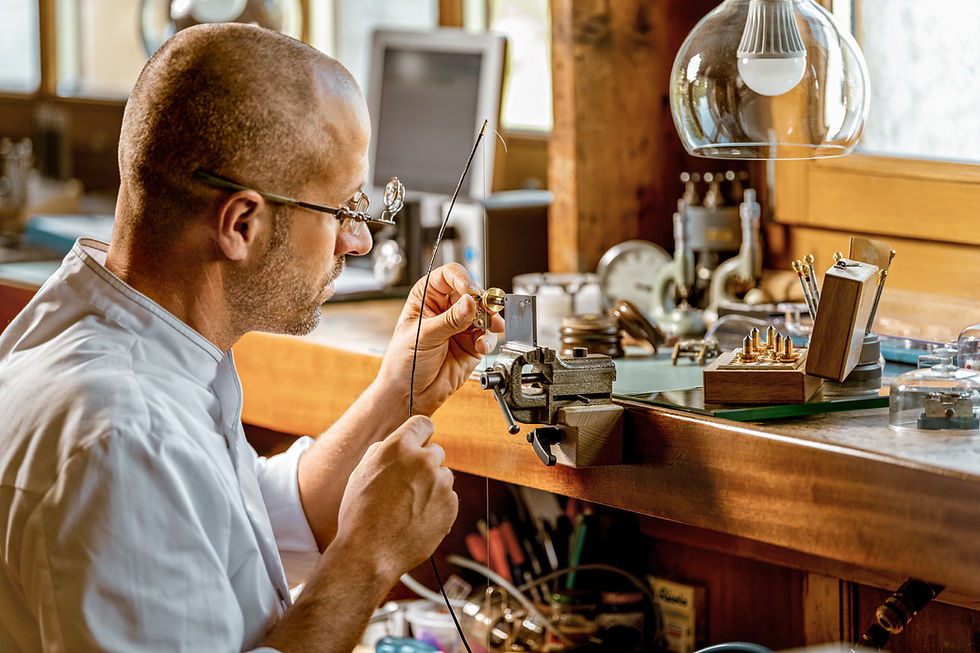
Nature, mountains, science, and history. Equally important is continuing the knowledge passed down through working alongside my father. Every day at the workbench is a dialogue between what I learned decades ago and what I discover today. Every moment is an opportunity to learn, and mastery is something built through daily practice.
Can you share anything about your upcoming creations?
This spring, during Watches & Wonders in Geneva in April, I will present a new model. It continues to embody the principles of historical watchmaking while integrating modern innovation. All components will be crafted from titanium, with the highest level of hand finishing. My focus remains on creating mechanisms that solve real mechanical challenges while ensuring ergonomic design suitable for everyday wear.
![[인터뷰] 파네라이 최고 마케팅 & 제품 책임자 알레산드로 피카렐리](https://static.wixstatic.com/media/bd93d4_89dff41ae31049f0ac8f64838cfebb22~mv2.jpeg/v1/fill/w_980,h_653,al_c,q_85,usm_0.66_1.00_0.01,enc_avif,quality_auto/bd93d4_89dff41ae31049f0ac8f64838cfebb22~mv2.jpeg)

![[인터뷰] 브레게 헤리티지 디렉터 에마뉘엘 브레게](https://static.wixstatic.com/media/bd93d4_070afa34ba844fb7979cb913c3339c37~mv2.jpeg/v1/fill/w_980,h_1306,al_c,q_85,usm_0.66_1.00_0.01,enc_avif,quality_auto/bd93d4_070afa34ba844fb7979cb913c3339c37~mv2.jpeg)
댓글